
AT THE CHART TABLE · OCTOBER 2026
Letter One · the last fix
The Last Fix
How this was made: drafted by Claude, an Anthropic AI model, from the author's memories and a research record that Anthropic models researched and reviewed. The author directed it, checked it and revised it. Every figure is checked word for word against that record.
A beginning is the time for taking the most delicate care that the balances are correct.Frank Herbert · Dune (novel, 1965) · In-world source: "from 'Manual of Muad'Dib' by the Princess Irulan"
There's a pencil line on the chart in front of me, running from one small circle to the next. A chart is a map of the water, and each circle on it is a fix: a position checked against something outside the boat, a lighthouse or a star, so that for that moment the navigator knew where he was. The newest circle is the last fix. Everything pencilled beyond it is reasoning.
That reasoning has a name, dead reckoning. You take the last fix, your speed, your heading, which is just the way the bow points, and the time gone by, and you walk the position forward along the line. You also say how far wrong you might be, and the error grows every hour you go without a new fix.
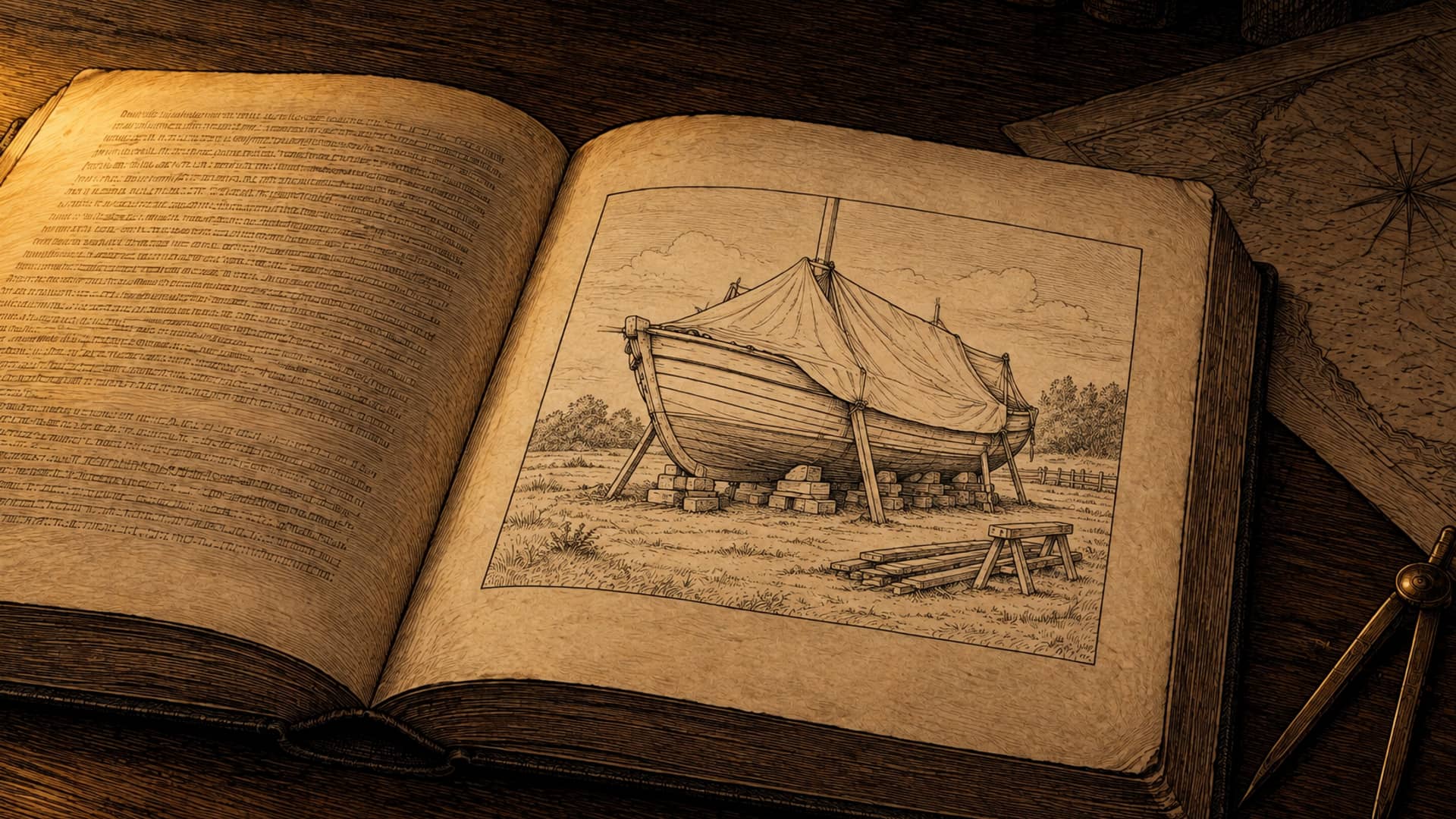
Joshua Slocum's book lies open beside the chart. He was a sea captain at a time when the sailing ships he knew were going out of use, and the book is the story of the boat he sailed alone. It begins with the offer of that boat, which came with a condition.
Come to Fairhaven and I'll give you a ship. But," he added, "she wants some repairs.Joshua Slocum · Sailing Alone Around the World (1900) · Spoken by "an old acquaintance, a whaling-captain"
"Some repairs" is a generous phrase. Slocum rebuilt her himself, starting from the old hull, because that was the boat on offer. Most beginnings are like that: you start from the boat you're given and the position you last checked. So that's where this letter starts, Emma, with the last places someone actually checked.

One shift I can tell you about from the inside began, for me, in 2007. I was twenty-seven, a junior developer in my brother's contract development shop, Own Vision. A contract shop sells hours. It writes software for other companies and bills by the hour, and when the hours stop, so does the money. We wanted revenue that didn't depend on billing hours.
The shop's name came from a line of Ayn Rand's.
men who took first steps down new roads armed with nothing but their own visionAyn Rand · The Fountainhead (1943) · Howard Roark's courtroom speech
"Armed with nothing but their own vision" is a fine thing to put on a door. The truth behind my idea was plainer: we needed revenue, and the phone had GPS.
My pitch was to turn the GPS already inside the phone into a golf rangefinder, a tool that tells a golfer how far it is to the flag. On the courses I played, most golfers got that number the slow way. They found the yardage marker, a plate or post set at a known distance from the green, and paced off the gap between it and their ball, counting under their breath while the group behind them waited. That's my own experience of the game, not a measurement. But it was the pain the idea was for: the golfer's time.
I built the prototype at the laptop. Early map imagery of a course went on the screen, I clicked out the course points by hand with a map plugin, and the program measured from the phone's own position to the point I'd clicked for the flag. The first distance came up as a plain number. I took it as proof the hard part was over. At twenty-seven I took a lot of things as proof.
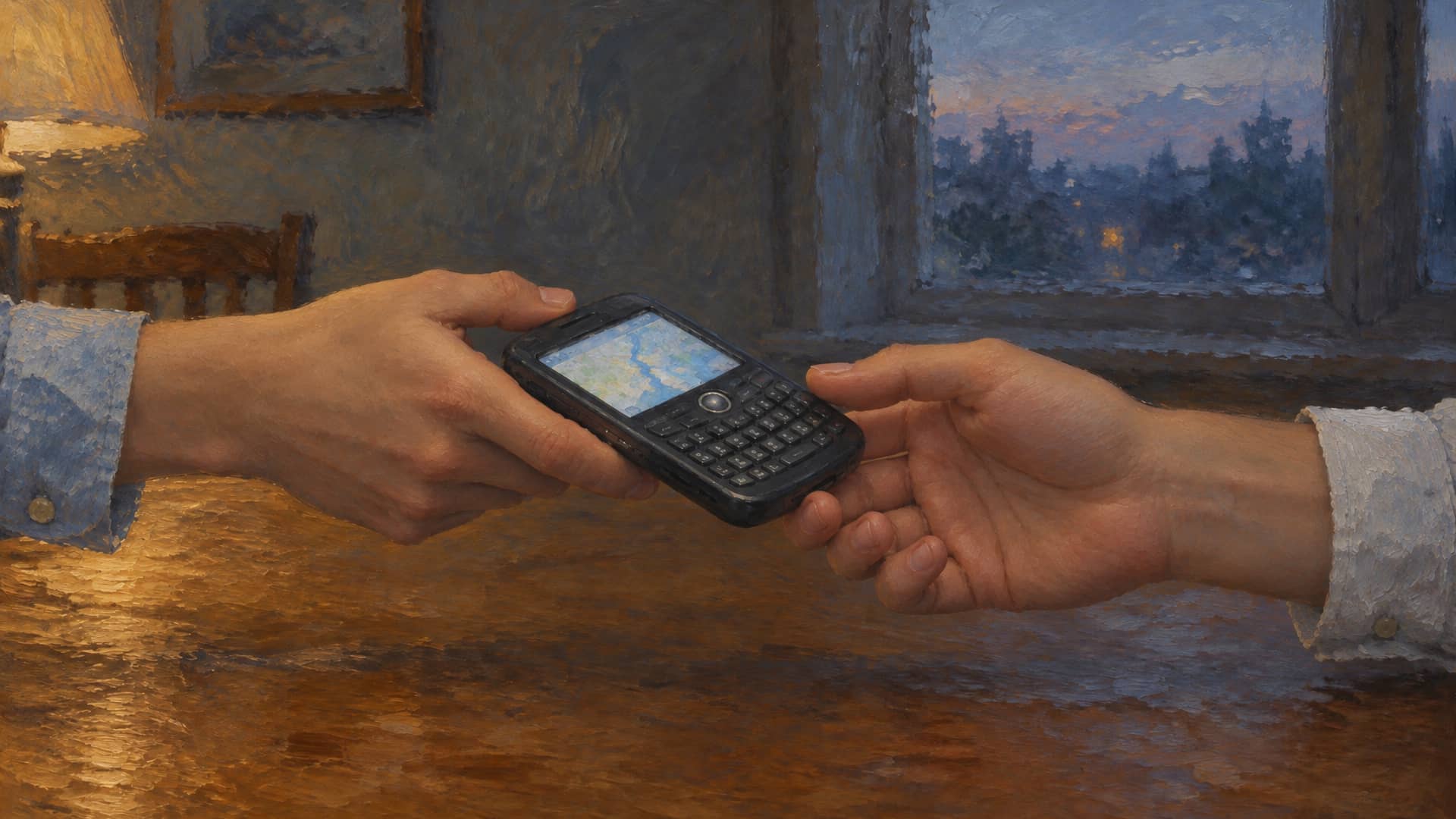
Then I installed it on my brother's phone, a BlackBerry Curve, a business phone of that era with a small keyboard under the screen. He tried it, and what he did next was take on the whole business end himself. From then on he ran the company and its sales, and he created the newsletter and ran it. Monique, his wife, worked on sales and curated the newsletter. Bobbi, our mother, was a part-time developer with us, and she's the reason both her sons went into software.
I kept the technical side: the builds, the server side, the infrastructure. I could make the thing run. He made it something people could buy.
Here is the question under all of these letters. In 2007 knowing where you were turned cheap all at once: it came built into a phone. When something that used to cost real money turns cheap, who comes out ahead?
I couldn't have told you then. The answer tends to show up later, in accounts that have closed. So the fixes I can give you come from earlier shifts, whose books were closed long ago. There are three.
Herbert's line at the head of this letter asks for "the most delicate care" at a beginning, so "that the balances are correct". I took no delicate care at mine; I had a phone with GPS and I started building. The care I can take now is in reading the old balances: what each one measured, and what it didn't.

The first fix is the railways in Britain in the 1840s. Railways were the cheap new way to move people and goods, and money poured into them in a frenzy, which is what you call the stretch when everyone piles into the new thing at once. Then the frenzy broke. Two economic historians, Campbell and Turner, found that railway share prices "had fallen by 66 per cent from their peak by April 1850". Over 1843 to 1850, what a shareholder in the established railways got back, price and dividends together, was "close to zero".
From the recordLF-PS-111
From the recordLF-PS-109
The riders are in the record too, but in a different unit. An economic historian, Leunig, modelled what passengers saved by taking the train instead of the old ways of travelling, and put those savings in 1912 at 14% of Britain's national income. That's a model, not money anyone banked, and the research says so plainly: users are "the most plausible destination and the least measured".
From the recordLF-PS-172
From the record · not shownLF-M-101
So paying for the build and gaining from it were two different things. The money that built the railways mostly didn't get the gain. The riders most plausibly did, and nobody counted it in cash.
I know that kind of gain from the golf course. A golfer who no longer had to pace off his distance got some of his own time back, and nobody wrote that down either.
The second fix asks who kept the profit once things settled. The best-measured case is the personal computer. A firm's margin is what it keeps from each sale after paying to make the thing and run the business, before interest and tax. From 1991 to 2000, the firms that owned the PC's standards, Intel for the chip and Microsoft for the operating system, kept an operating margin of 36.6% between them. Four firms that assembled and sold the machines kept 5.6%. Those figures are computed from the companies' own filings.
From the recordLF-PS-021
Almost nobody could build a PC for that market without that standard, so nearly every sale passed through its owners on the way to a buyer. The plain name for that is a point of passage, and that's where the profit sat.
One caution travels with that fix. A study of a later period, 2000 to 2005, by Shin, Kraemer and Dedrick, measured returns on what each firm owned, not margins, and found "the differences are minimal for return on assets (ROA) and return on equity (ROE)". So margins differed by position, and in that study returns barely did. A high margin isn't automatically a high reward, and I keep both studies on the table.
From the recordLF-PS-001
I met that kind of point from the builder's side before I had a name for it. Our builds went in order. First came J2ME on the Curve 8330: J2ME was an old, limited way of writing small programs for phones, from before there were app stores. Then a modified version for the Storm, BlackBerry's touch-screen phone, then the iPhone, then Android. Each one ran on a platform someone else owned, and it reached a golfer only by passing through that platform.
The third fix is the nearest to my own water, and it's here because golf was mine. Before phones, a machine that knew where you were came as a box you bought. Garmin sold those boxes. In fiscal 2007, its peak year, its car and mobile navigation segment, the slice of the business it reports separately, earned US$608.75 million in operating income.
From the recordLF-PS-154
Then the phone took over the job. That's my reading: the filings show the fall, not why it happened. TomTom, which made the same kind of box, saw its consumer segment go from 246.6 million euros of operating profit in 2009 to a loss of 3.9 million in 2016, and even that loss includes a one-off gain.
From the recordLF-PS-156
As for the firms that built on the cheap new capability, the golf GPS apps: the research checked seven of them, and none has disclosed an operating profit. That's a gap in what they published, not proof that they lost money.
From the record · not shownLF-M-107
That was the kind of firm we were, building exactly that cheap capability and aiming it at golf. Our own numbers stay out of this letter. The box makers' profit fell away, and on the record the app builders who took up the same capability didn't visibly pick it up.
When the build was ready for a real course, I emailed my brother the details. He was away on a business trip. He installed it on his BlackBerry himself, played a round on a course I never saw, and wrote back with the results.

I read his reply at my desk that evening. It was the app's first real fix, taken against real ground, and I read it as news of where we stood. It was a report of where we had stood. By the time I read it, the round was over and we had all moved on from it.
Every fix in this letter is like that email. The railways, the PC standards and the navigation boxes are well-kept records, each sound at the place and hour it was taken, and the boat has moved on from all of them. Today isn't even recorded in the same units. The old shifts were measured in profit, and much of what's measured now is prices and terms.
So the old fixes can't tell you when anything will happen. What they tell you is where to look: at who pays for the build, at who gains without being counted, and at who holds the point everyone else has to pass through. A fix tells you where to look, not when. The answer to not knowing the future isn't a better guess. It's a well-kept last fix.
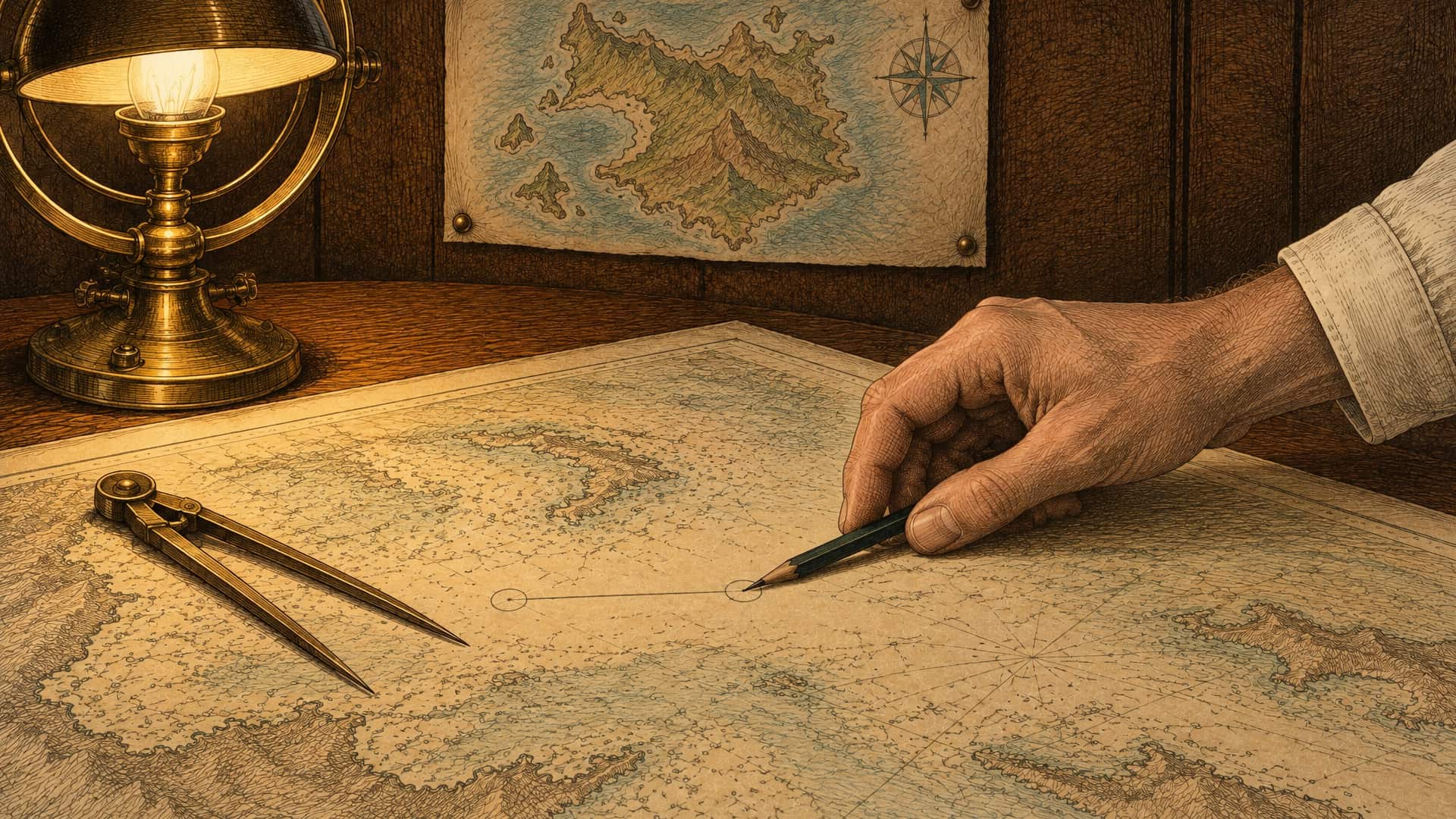
So here is the working, Emma. When you want to know where you stand, start from the last thing you actually checked against the world outside your own head, and write down when you checked it. Then reckon forward out loud: how far you've likely come since, and how much wider the error has grown. Pencil it lightly, so it can move.
Know your last fix, and know it is behind you.
Navigator's Note
- a fix: a finding from the record
- the record on what it doesn't show
- my reckoning
- the log: my own public record
The memories in this letter are mine, told as I remember them. They're story, not evidence. The findings come from the research record, and each receipt opens to the row behind it.
These letters are produced by managed AI agents in Terrence's voice; the research and its readings were produced by Anthropic models. The direction, the checking and the revisions are mine. Anthropic sells AI, and parts of this record set AI beside human work, so weigh that as you read.