The Garden Opens
An original story in the world and voice of George MacDonald.
She got up. There was no resolution in it, and no will that she could find; her legs rose under her because they were tired of sitting, as they had been tired of walking, and would presently be tired of standing.
She filled the can at the pump. The water was heavy. Her hands knew that; they had known it all day. But they were no longer reporting to her mind about it, and her mind had left off inquiring; and so between them there fell a kind of truce--not peace, perhaps, but the cessation of a quarrel whose cause neither combatant could remember.
She carried the water back to the beds and poured.
It went in quietly. The dark earth received it as a thing expected, drawing it down and away into whatever deeper earth lay beneath; and the soil darkened where the water soaked, a colour richer than she had noticed before--not black but a deep warm brown, the brown of strong tea, of turned wood, of autumn in its early generous weeks. I do not think she saw all this with her understanding; she saw it with her hands and her knees and the small of her back, which is a truer kind of seeing, though the philosophers have not much to say about it. For there is a knowledge that enters through the fingers, as light enters through the eyes; and it is, I sometimes think, the older knowledge, and nearer to the root.
Now here was a curious thing:--the hands that had fumbled and bruised and broken all morning were neither clumsy nor careful. They moved in the bed, and drew out a clump of chickweed that had rooted among the seedlings, and laid it aside, and firmed the soil where it had been; and her fingers knew the pressure needed without consulting her. They were not skilful. They were only present. And that was enough; for the earth does not ask skill of us, but only that we should attend to what is before us and let the thing that wants to be done, be done. It is a grace;--but I find that the word frightens people who need it most, and so I will say instead that it is a gift, which means the same, though it sounds less like Sunday.
The old woman knelt at the next bed.
Emma did not see her come. She was simply there, as the pump was there, as the stones in the path were there. Her hands worked in the same rhythm--not Emma's rhythm adopted, but a rhythm that had found them both, the way two clocks upon the same wall will fall into time with one another though neither knows the other is ticking. They did not speak. There was nothing that speech could have added to the silence between them; and that silence was not empty but full, the way soil is full--packed close with the small dark life of things that do not need to be seen in order to be at work.
I said the old woman was simply there. But I must correct myself; for there are degrees of simply, and hers was of a kind that went very deep. She knelt in the dirt with her hands in the earth beside a girl she had scolded and instructed and let alone by turns all the long day, and she was content to be there, and that contentment came off her the way warmth comes off a stone that has lain all afternoon in the sun. It was not a lesson. She was not teaching. She was only present--but it was a Presence that had something behind it vaster than an old woman's patience, as the sky behind a window is vaster than the window, though the window is all you see.
A seedling stood where Emma had set it. She had transplanted the thing without deciding to; her hands had known that it was ready, had eased it from the crowded row, and opened a place, and set it, and firmed the earth around its small roots. It stood--green, and leaning very slightly toward the afternoon light. She did not remark upon it. She did not say to herself that she had done rightly. She only saw that it was standing, and that the light fell gold and long across the beds; for the sun had come lower and grown kinder than he had been all day, and his warmth lingered upon the soil like a father's hand resting where it need not press.
Her mind stirred once, wanting to name what had changed. But her hands were in the earth, and they were busy; and the naming did not come. There are doors that open only to those who are not trying the handle; and there are questions--the deepest, I think, and the most necessary--that are answered not in words but in the substance of living, the way a root is answered by the rain. After a while her mind grew quiet again, like a child that has asked a question and fallen asleep before the answer--not because the answer did not come, but because it came so gently, and was so much larger than the question, that the child could not tell the difference between receiving it and rest.
She rose and filled the can again. It was heavy; but the heaviness was good, and her arms knew it, and were glad of it—for arms were made to carry, and a burden that fits the arms is no burden but a completion.
The archways stood open. She had not seen them so before; but then she had not looked rightly, or she had looked too hard, which amounts to the same thing as not looking at all. I am not sure that she had even known the archways were there—but that is the way of doors and arches and all manner of openings: they show themselves when the one who would pass through them has ceased to push. Stone steps went down between low walls into a lower garden, and the air that came up was cool and green and smelled of earth that had been breathing a long while undisturbed. She went down. The light fell through the leaves of an old pear tree and lay in spots upon the dark beds below, shifting when the wind shifted; and she thought the spots looked like small hands opening and closing upon the soil, though perhaps that was only the way things seemed to her now that her own hands had been opened.
It was quieter here. There was that in the air which I can only call patience—the patience that earth learns from water, and water from the sky, and the sky from something older and kinder than any of them. But I ought to say what I mean by patience, and I am not sure I can. It is not mere waiting. A stone waits, and there is no virtue in it. But the patience I mean is the kind that belongs to a thing which could act and does not—which holds its life in, not because the life is feeble, but because the hour for spending it has not yet come; and that is nearer to what we call death than most people would like to admit, and nearer to what death really is than most people have ever guessed. For a seed is patient in just that way—it lies in the dark and does not push, and to all outward seeming it has died; and yet the life in it is not less but more, being gathered and collected and drawn inward, waiting for the moment when the soil says, in whatever way soil speaks—and I do not know the language, though I think it may be water—'Now.'
She poured and did not measure. The soil drank at once, as a thirsty child drinks—with a kind of dark gladness; and where the water sank there rose a smell of earth so rich and old it was almost a taste, the smell of rain on warm stone, of cellars, of the first turned furrow in March. It was alive. It had always been alive. She had only now the eyes to see it—but I think, perhaps, it had also been waiting for her to see it; for there is that in living things which is not fully alive until it is known, as a word is not a word until it is heard.
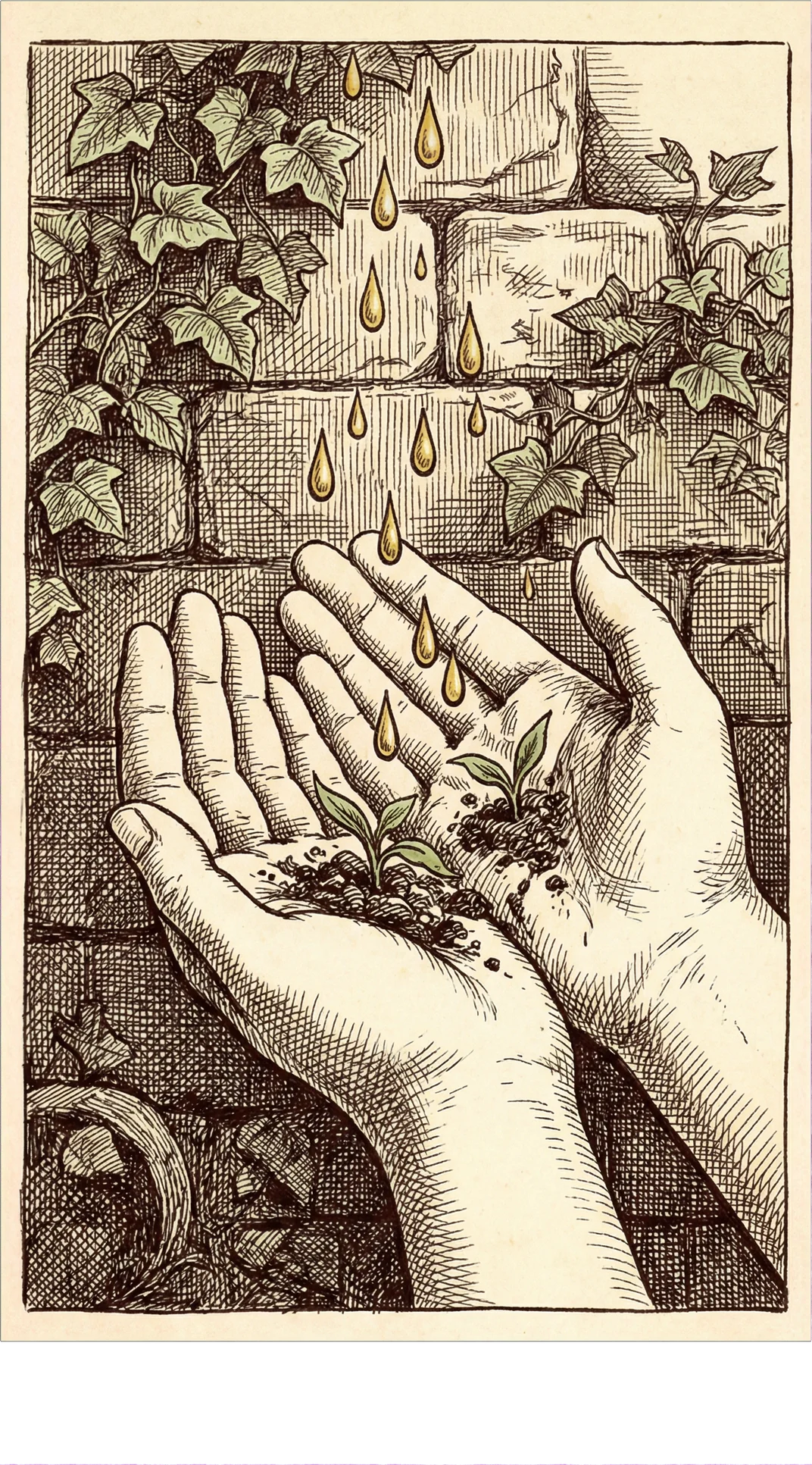
In the farthest bed, against the south wall where the stone had held the day's warmth all the day long, something was growing. Green shoots—three, or it may have been four—pressed up through the dark soil with that straight, unhesitating sureness that belongs only to things which have never once doubted their right to exist. She had not planted them. No one had planted them—or if some one had, it was long ago and in a manner she did not understand; for there are sowings that are not done with the hand, and harvests that come from seeds we did not know we carried, and fruit that ripens in us ere we have tasted it. She had not tended this bed. She knelt.
I cannot tell you why she wept. She could not have told you herself; and I will not pretend to explain what she could not, for that would be the worst sort of dishonesty—the sort that makes a tidy thing of what ought to remain untidy. The tears were not grief, for she had lost nothing—or rather, she had lost a great deal, but what she had lost was a thing she was well rid of, and the losing of such a thing is not grief but something for which I have no word, though 'deliverance' comes near it and 'death' comes nearer, if by death we mean the falling away of what was never truly alive. Neither were they joy, for she had gained nothing she could name. They were the body's own water, rising because it must, as water rises and has always risen since the world began—up through root and stem and branch and out at last into the air; and whether it falls as rain or as tears matters nothing to the earth. And the tears fell into the soil; and the soil received them as it had received the water from the can—without distinction, without preference. Tears and well-water and rain are all one to a garden. The earth does not ask whence its drink comes, any more than a father asks whether the child that has come home travelled by the east road or the west.
She knelt a long while. The shadows moved and she did not move. I think she might have knelt there till dark—and there are worse places to meet the dark than kneeling in a garden—but the old woman spoke.
"The evening is coming on," she said. Her voice was near and quiet and warm, like bread—no, not like bread; like the smell of bread, which reaches you before the bread itself and tells you that someone has been at work in the kitchen and that the house is alive. "It will be a good walk home. The light is long, this time of day."
Emma lifted her head. She wiped her eyes with the back of her hand, and the soil that was on her fingers left a dark mark beneath each eye, like a child that has been playing in the dirt all afternoon—which, I suppose, is near enough to what she had been about, though she would not have called it play an hour ago, and I am not certain she would have been wrong to refuse the word. But stop—I said she would not have been wrong, and I must think about that. There is a play that is more serious than all our labour, and a labour that is lighter and more idle than any game; and we have got that so thoroughly backwards in this world that the very word 'play' has come to mean a thing of no consequence, when in truth—but I will not press the point. I have pressed too many points in my time, and bent the most of them.
She did not answer the old woman. She did not need to. The silence between them had been long and good and full; and her own silence now was not refusal but the deepest kind of agreement—the kind that lives below speech, in the body, where the truest things have always kept house, and where, if I am not mistaken, they will keep house long after the tongue has said its last word and the ear has closed its door.
The light was going. The gold had thickened to amber, and the amber was darkening at its edges, and the shadows of the pear tree lay long and quiet across the beds. And then—I do not know how to say it but plainly—the garden looked up. Not the flowers only, and not the leaves, but the whole of it, the stones and the soil and the walls and the water that was sinking still through the dark earth: the garden lifted its face to the coming evening and was glad of it, as a child is glad when it hears its mother's step upon the stair, knowing that the step means bed, and that bed means darkness, and that the darkness is nothing to be afraid of because the mother is in the house. Somewhere above them a wood pigeon called once, and was quiet; and the quiet that came after was deeper than the quiet that had been before, as the sleep that follows a long day's work is deeper than the sleep of one who has done nothing—and sweeter, too, though I cannot tell you why.