The Walk Home
An original story in the world and voice of George MacDonald.
The path home was the same path. She had walked it a thousand times. In rain; in frost; in the long grey sameness of February when the sky sits close and will not lift. She knew every gap in the hedgerow and every crack where the grass had shouldered through the pavement, as one knows one's own hand—which is to say, she had long ceased to see any of it.
But now! The hedgerow was burning.
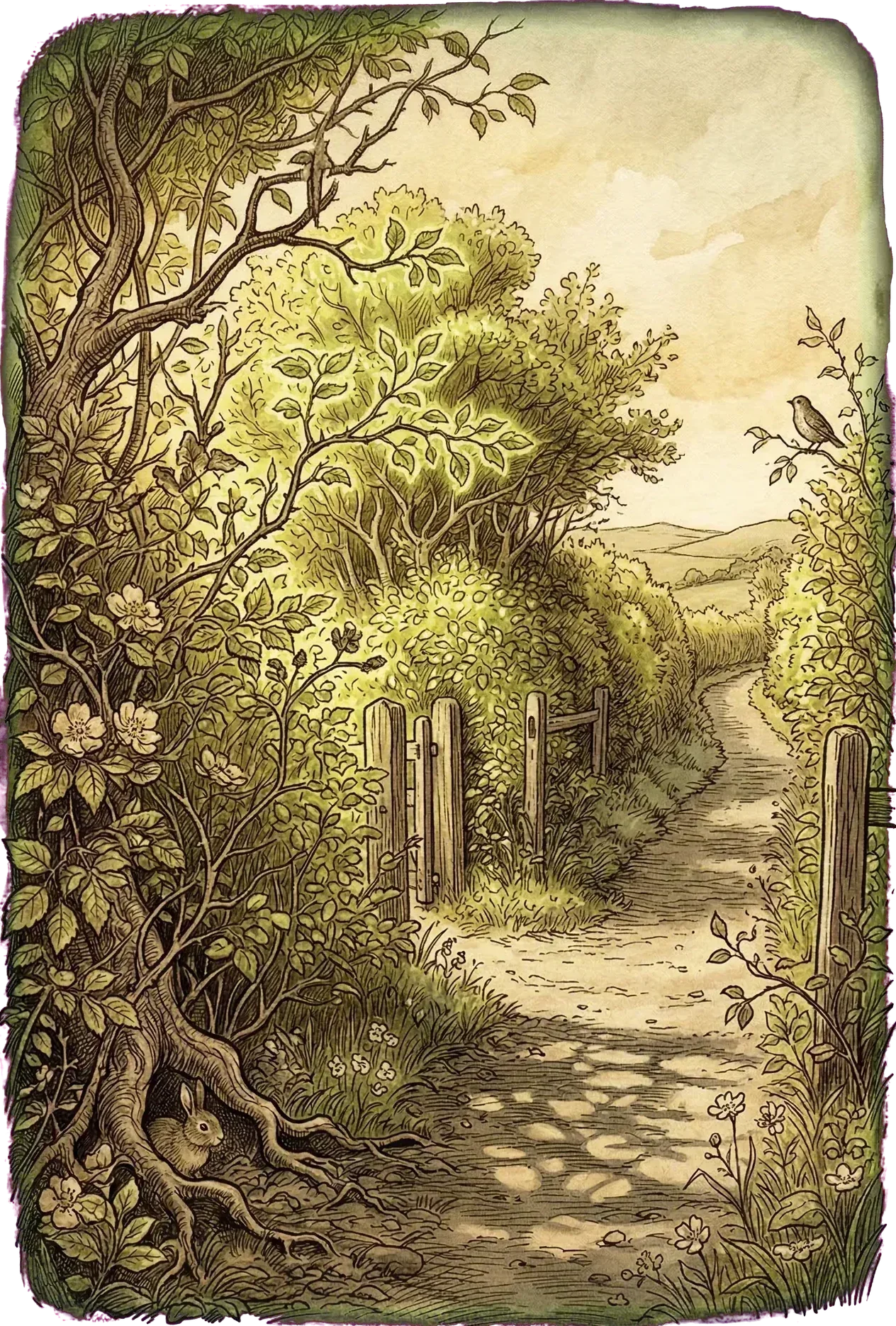
Not with fire. With itself. Each leaf held the late light and returned it altered—a kind of luminous reciprocity, if that is the word; I am not sure it is, and I have looked for a better one and not found it, and so must go on with what I have, which is the way of things more often than we like to admit—as a child receives a gift and gives back thanks that the giver had not asked for and does not need and yet would not be without. Emma listened. She had not known that a hedgerow could speak; but then she had not, until that afternoon, known much of what things could do when they were let alone to do it. And that is the greater part of knowledge, I sometimes think—the part that consists in ceasing to stand between a thing and its own nature.
The light ran along the upper branches. It dripped through the lower. Where it fell upon the cracked pavement it pooled like shallow water, and the pavement drank it as the garden had drunk the water she poured—thirstily, and without remark, and with that frank greediness that is not greed at all but only the honest acceptance of what comes.
She stopped.
Something had changed in the quality of the air—or in her; but I think it was in the air, for the change had a direction and came from ahead of her and not from within. The hedgerow seemed thinner than it ought to be. Not damaged; not sparse. Thin in the way that a curtain is thin when light presses through from the other side and you can almost see the room beyond. And through that thinness—just for a moment, and then gone—she saw, or thought she saw, another country: not different from this one but deeper, as a face is deeper than its photograph; and in that country the same road ran, and the same hedge grew, but every leaf was awake and singing, and the light did not fall upon things but rose up out of them from within, as though the sun had been buried long ago in the hearts of them and was finding its way home.
It lasted the space of a breath. Then the hedgerow was a hedgerow again, and the road a road, and Emma stood in the ordinary evening with her heart knocking hard against her ribs.
But the ordinary evening was not what it had been. Something of that deeper place—call it the truth of the place, for I think that is nearer than any other word I can find, though it is not near enough, and I doubt that any word in English or out of it could get near enough, for the thing itself is not made of the same stuff as words—lingered in the surfaces of things. A fragrance that had no source. An adumbration of what things truly were, and always had been, beneath the film of her long inattention.
I cannot account for such moments. I have tried—and I ought to say that I have tried not as a philosopher tries, sitting in a chair and turning the thing round and round in thought until it is worn smooth and has lost all its edges, but as a gardener tries to account for the crocus that appears where he did not plant it, or the good crop that comes from ground he had given up for barren. One does not earn them. But they are never given, I think, to those who will not work. And that is a strange economy, and I have a good deal more to say about it, but I suspect it would be tedious, and besides I am not sure I understand it myself, and a man ought not to say more than he understands, though he very often does; and I am as guilty of that as any man living.
But I was speaking of the walk home. What had happened was this: a day's labour in another woman's garden, and soil under the fingernails, and water carried and poured and carried again until the carrying became a kind of glad obedience—that these had cleaned the film from her eyes. And what was the film made of? I suspect it was made of Emma. Or rather—and here I must be careful, for the thing is slippery—it was made of that false Emma which had sat in the seat of her soul and called itself by her name. A shadow merely; and a shadow does not depart so much as cease to be cast, when whatever threw it moves into the light.
Let us return to the road.
She reached her door. It was blue—had it always been so very blue? She could not remember having seen it before, and I mean by that a thing which is difficult to say plainly: that she had seen it every day, and opened it, and closed it, and leaned against it while hunting in her pockets for her key; but she had never in all that time received the blue of it. And receiving is a different operation from seeing entirely—as different as drinking is from looking at water, or as being loved is from knowing that one is loved, which last difference I suppose I need not explain to any but the very young and the very fortunate. The colour struck her now with a gentle astonishment. It was not merely paint. It was—but I shall not say what it was, for Emma did not say, and I will not put words into a seeing that had no words in it. She stood and looked at her own door as though she had come home from a long journey; and I suppose she had.
The cats met her before she touched the handle.
Two orange cats, the colour of marmalade and autumn and certain kinds of late-afternoon trouble—for all cats are troublesome, and orange cats most of all, and I say it who have kept them and been kept by them, which is the more accurate description I leave the reader to determine. They pressed against her shins with that rough and resolute insistence which cats reserve for those who have been away too long and not long enough. She knelt. She put her soil-dark hands into their fur.
Warm! Simply warm. I do not say it was a symbol. Symbols are for those who stand outside a thing and point at it. Emma was inside the warmth; and warmth is never merely warmth, for every warm thing participates in the first warmth, though it does not know it and is none the worse for not knowing; and I think there are a great many things in this world that are like that—participating in something they cannot name, and none the worse, and perhaps the better.
But now—and here I must come back to the story again, for I had nearly wandered off into a meditation upon warmth, and warmth is a subject upon which one could meditate for a good while, and I have not the space nor, I suspect, the reader's patience—a common thing happened, which is stranger, if you think about it, than any uncommon thing could be. She was kneeling on her doorstep with her hands in the cats' fur, and a snail was crossing the step beside her. A brown garden-snail, its shell banded in cream and umber, moving with that slow, certain, glass-smooth gliding that snails have—as if the whole world were a road made for it personally, and it had all the time that time contained. She watched it. She could not have said why. A week ago she would not have seen it at all, or if she had, she would have thought that it was a snail, and nothing more—the word falling over the creature like a sheet thrown over a piece of furniture, so that the thing itself disappeared beneath the label. But now she saw the snail, and the snail was—a snail. And that was an astonishing thing to be. I wonder whether it knew it. I rather think it did, and had always known it, and thought nothing of it, for creatures that have never lost a thing do not know that they possess it; and perhaps that is the deepest difference between snails and men, and it is not in our favour.
She went inside.
The kitchen. Evening light lay across the table in long amber bands—the same quality of light, and I marked it and set it down, that had pooled in the old woman's garden among the roses. It did not discriminate. It did not prefer roses to a bread-board, or a garden to a kitchen, and I think it was right in that. Her mother stood cutting bread. Her father sat with the newspaper folded to the crossword, and a pencil behind his ear, and that expression of comfortable perplexity which crossword-solvers wear when they are happy and do not know it.
And these two people! Whom she had known every day of her life, and whom she had lately regarded with the faint impatient condescension that clever children reserve for parents who are not clever in the way they value—these two were simply and entirely themselves. That was enough. It was more than enough; it was everything. They were not what she had made of them in her mind; they had been made by Another, and she had not, until this evening, thought to look at the Maker's work. And I think that is the commonest sin, and the least dramatic, and perhaps for that reason the last to be repented of—that we look at people and see only what we have decided about them, and call that seeing, and are proud of our discernment; when all along the real face was there and we had pasted our own drawing over it.
"There you are," her mother said. "Supper's nearly ready."
That morning those words would have stung. To be expected! To be merely a fact on a schedule, like the post or the bus! But to be expected is to be awaited; and to be awaited is to be wanted; and to be wanted—but I need not finish; Emma heard it, and that is enough. She heard the love in it, plain and unadorned and not at all clever; and she sat down.
A glass of water stood on the table. Just water, from the tap, in a plain glass. But the evening light passed through it and threw a trembling circle of gold upon the wood; and Emma looked at it, and thought of the watering-can, and the bucket, and the long afternoon; and how the water had gone down into the dry earth and found the roots that could not come up to find it; and how everything that lives must first be found by something that gives itself away. That is the economy of water. And I think—but I have said enough about what I think; the reader is patient but not, I trust, infinitely so.
Her hands lay in her lap, the soil still dark in the creases of her knuckles—ground-in, badge-dark, work-remembering soil that soap and water would presently remove. But what the garden had worked further in, that I do not think soap reaches; and if it did, I should not wish it to.
Whether what was planted there will grow, I cannot say. I have been wrong about such things before—spectacularly wrong, in two instances that I should rather not discuss—and the heart is a strange field; and a field is known by its crop and not by the planting.
Outside, rain began. Thin and quiet on the window, as though the sky too were pouring out what it had carried, and was glad to be rid of the weight of it. The water ran down the glass in small rills; and beyond the glass, in the dark, her own garden—not the old woman's, but her own small plot, which she had never much regarded and which had got along without her regard tolerably well—drank.
I wonder sometimes at how little it takes. And how that little is never what we would have chosen! Not a vision; not a voice; not the sort of catastrophe or revelation that the proud heart would accept as adequate cause for its own unmaking. A day's work. Water carried until the arms ached. A snail on a doorstep. And then you walk home along the same path, and for one half-breath the hedge is thin; and then it is only a hedge again; but you are not only yourself, for you have seen something that you cannot unsee; and your mother is cutting bread; and the cats are warm; and the kitchen light and the garden light are the same light; and the rain falls on both, and on you, and on the snail, and on the bread-board, and on the old woman's roses; and it is all one water, and it is glad.
But whether Emma kept that seeing—whether she woke the next morning and found the door merely blue and her parents merely ordinary and the snail merely a snail again—that is another question, and not mine to answer. I will say only that she sat a long while at the table, with the rain on the window and the bread on the board and her two cats sleeping heavy and warm at her feet; and that her hands, which had learned that day what her mind could not yet say, lay open and still in her lap; and that the evening came in around her like a word spoken very quietly by someone who had been waiting a long time to say it, and had not minded the waiting, and would have waited longer; and that she received it.