Water Carried in Anger
An original story in the world and voice of George MacDonald.
And now I must tell a strange thing; or rather, a thing that would have seemed strange to Emma, had she been attending to anything but the sound of her own voice. The garden was smaller than it had been.
I do not mean that it seemed smaller, in the way that a room seems smaller when one is unhappy in it. I mean that it was smaller. The hedges along the eastern wall had come nearer—not as a thing moves that you can catch moving, but the way a sorrow comes nearer, so that you cannot say when it arrived, only that it is closer now than it was. And the paths between the beds had narrowed until Emma could not have walked two abreast in them. And the archways—those archways that had opened that morning toward the deeper ground, toward inner gardens she had glimpsed through gaps in the green, where the light fell differently and the air carried the smell of things she could not name—those archways were gone. Not closed; not hidden behind new growth; but gone, as a door is gone when the wall has quietly decided to be a wall and nothing more. The garden had drawn its heart inward and away from her, the way a creature folds itself small against a frost, the way a father turns his face aside—not in anger but in that grief which is too near to anger for the griever to tell the difference.
But I must speak of the sun; for he was there, and he had been there the whole morning, and he was not what Emma supposed.
He beat upon her neck and upon her shoulders, and he was very hot and very near. And Emma felt the weight of him and thought it was judgment—for that is what clever people think when they are uncomfortable: that someone is judging them, and that the judgment is unjust. But it was not judgment. It was something much harder than judgment, for judgment may be appealed, and what the sun was doing could not be appealed. He was grieving. He grieved the way a father grieves who watches his child do a hard thing badly, and who will not do it for her—not because he lacks the love but because the doing is the gift, and to take it from her would be to take everything. He shone on the living seedlings and on the dead ones with the same great light, and on the old woman's quiet hands and on Emma's clever ones; and he loved them all; and the loving was very hot; and it did not help; and he did not stop.
I said that Emma's argument met no resistance. That is not quite right, or it is right but I have said it wrongly—for there is a kind of love that is the most absolute resistance in the world, only it does not resist the person but only the thing that is eating the person, and the person cannot tell the difference, and so feels resisted when in truth she is being fought for. But that is a deep matter, and I am not sure I have the words for it, and perhaps it is enough to say that Emma's words ran out.
They did not conclude. They did not arrive at any destination that satisfied. They simply ceased, the way a stream ceases when it has spread too thin across too wide a stone. And the silence that followed was very large. It filled the garden, hedge to hedge. It filled Emma too; and for one moment—one only, and she did not know what to do with it, so she let it pass—she felt how empty she was, how the argument had poured out of her and left nothing behind but the dry bed.
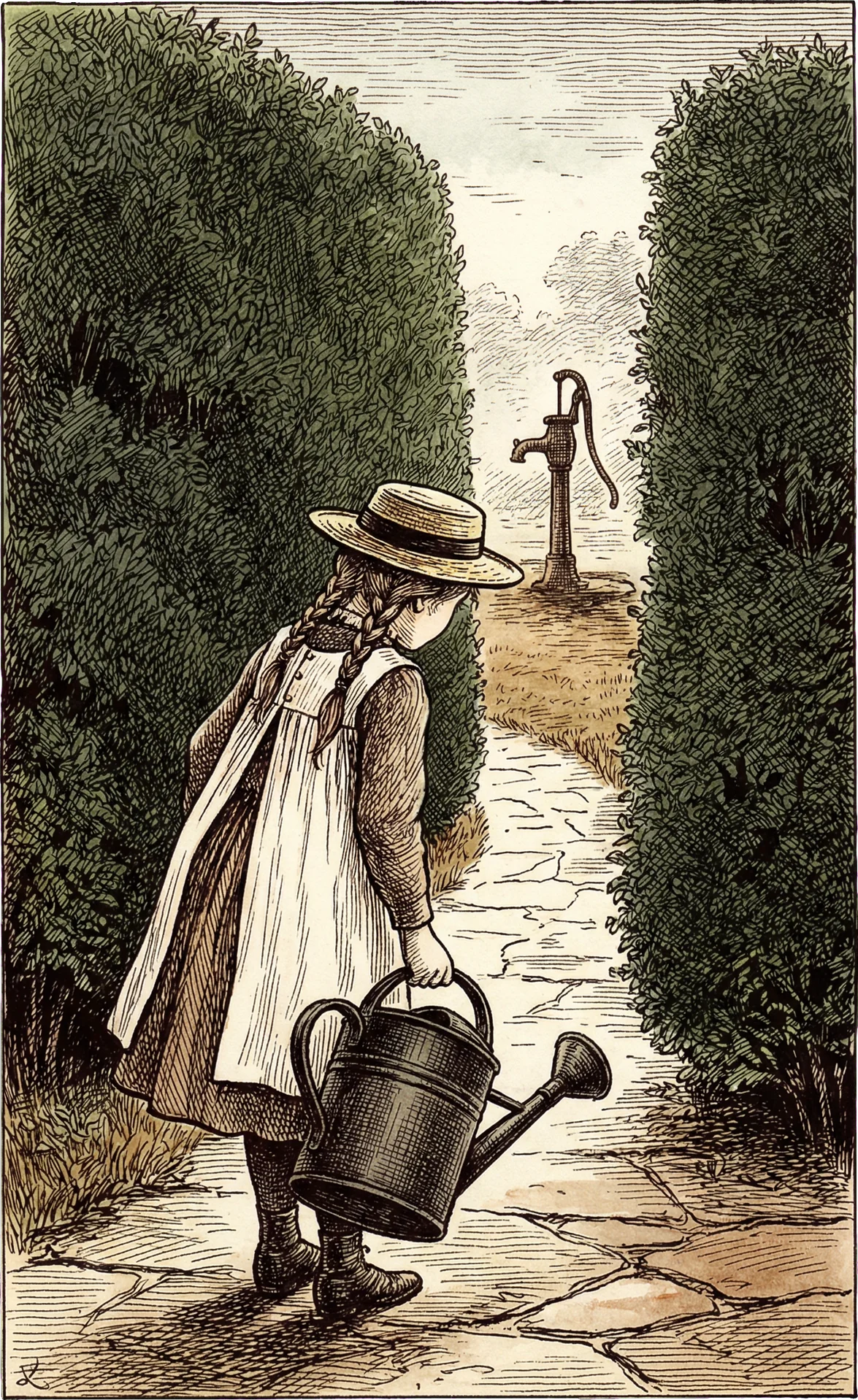
The old woman rose from her knees. She rose slowly, the way old people rise, and she brushed the soil from her fingers—each finger separately, the way one thanks a friend for a kindness, each one in its turn. She did not look at Emma's bed. She did not look at the dead seedlings. She crossed to the pump and took up the watering can that stood beside it; and it was iron, and it was heavy, and it was beaded with cold drops that caught the light; and it clanked against the stone lip of the trough with a sound that was—I think—the most real thing Emma had heard that whole morning. More real than her own voice had been. More real than her argument. A plain, iron, clanking thing that meant only and entirely what it was.
The old woman held it out. And she said—I must put down her words exactly, for she spoke so seldom that each word she gave was like a seed itself, and I would not lose one:—"They are thirsty."
That was all. She pointed toward the far beds—those beds that had not withdrawn, that still stretched away into the long heat of the afternoon, where the seedlings she had planted stood in their quiet rows and waited for water and did not care in the least who brought it or whether the one who brought it understood the first thing about soil composition or the chemistry of roots or any other matter that Emma could have explained and that the seedlings had no use for whatsoever.
It was not a rebuke. It was not an answer to her argument. It was not even—I think—a lesson; for a lesson is a thing that means to teach, and what the old woman offered meant nothing of the kind. It was the next thing; and the next thing asked nothing from Emma but her two hands and her willingness to carry; and perhaps—but this I say with great hesitation, for I do not understand it fully, and I do not think anyone does—perhaps the carrying of water to a living thing that thirsts is a kind of prayer; and perhaps it is the only kind that Emma could have prayed that morning; and perhaps it was enough.
She took the handle. The iron bit cold into her palms. The water sloshed and was heavy. She went.
The can was iron, and heavier than she had supposed. It pulled at her shoulder like a living thing that did not wish to go where she was taking it.
The old woman had gone back to her own rows, or perhaps she had not; Emma did not look.
Back and forth, back and forth. The pump stood where it had stood all morning, iron and patient at the garden's centre; the far beds lay a good sixty paces distant, past the cracked flags and the place where the path dipped and rose again over a buried root. She counted her steps the first three journeys. She stopped counting after that. The water slopped against the sides of the can and leapt out at every stumble, so that by the time she reached the beds her shoes were dark with it and the can half what it had been.
She poured, and watched. The water sat upon the surface of the soil in bright trembling skins, gathering in the low places between the mounded rows but not sinking. It pooled and shone and would not go down. She poured more; it ran sidewise along the little troughs and off the edge of the bed onto the path-stones, where it spread thin and began at once to vanish in the heat.
It was as if the earth would not drink what was given it so.
But she did not think this. She thought:--the soil is wrong; it wants loosening; there is a crust the old woman has neglected. She thought: the angle of the beds is poor, the water runs because the grade is against it. She assembled these thoughts like a barrister assembles papers, and carried them back with the empty can to the pump, and filled the can, and carried the thoughts and the water together to the far beds again.
Her hands blistered on the fourth journey. On the fifth, the blisters opened. The iron handle, warmed by the sun and by her grip, pressed into the raw new skin beneath, and she shifted the can to her other hand, and that hand blistered too. She catalogued the injustice of it:--the cracked path that ought to have been mended; the pump set too far from the beds it was meant to serve; the can itself, which was old and heavy and had no proper spout. Every return trip added a new particular to the indictment. She was building a case as sound and shapely as a sermon, and there was no one to hear it but the bees.
Through an archway to her left, stone steps descended to a lower level she had not seen before. Green darkness lay beyond, and something that might have been the sound of water--not pump-water, but water running of its own will, water that knew where it was going. She did not go down. She was busy. She had beds to tend. But the archway, and the steps, and the green below, withdrew a little further each time she passed, as a shy creature draws back from a hand too quick.
The afternoon thickened. The sun pressed on the walls like a palm pressed flat. Her arms ached from the shoulders down. Her thoughts, which had been so fluent, began to stumble and repeat themselves; the indictment lost its shape, its clauses running together like the water on the path-stones. She was not thinking now so much as trudging, and the trudging had become the whole of her.
On the seventh journey--or the eighth; she had lost count--her foot caught the buried root where the path dipped. The can struck the stones with a sound like a bell with no music in it, and the water leapt out entire, a great shining sheet that hit the flags and flew apart into a hundred creeping tongues, and was gone. Every drop. Soaked into the cracks between the stones, run off into the dry gutter, taken by the heat. She sat where she had fallen, her palms burning against the warm flags, her knees drawn up, and did not rise.
She had nothing left with which to rise. That was the simple thing. Her body had come to the end of what it would do for her pride, and it stopped, as a horse stops, without consulting her.
The silence came in.
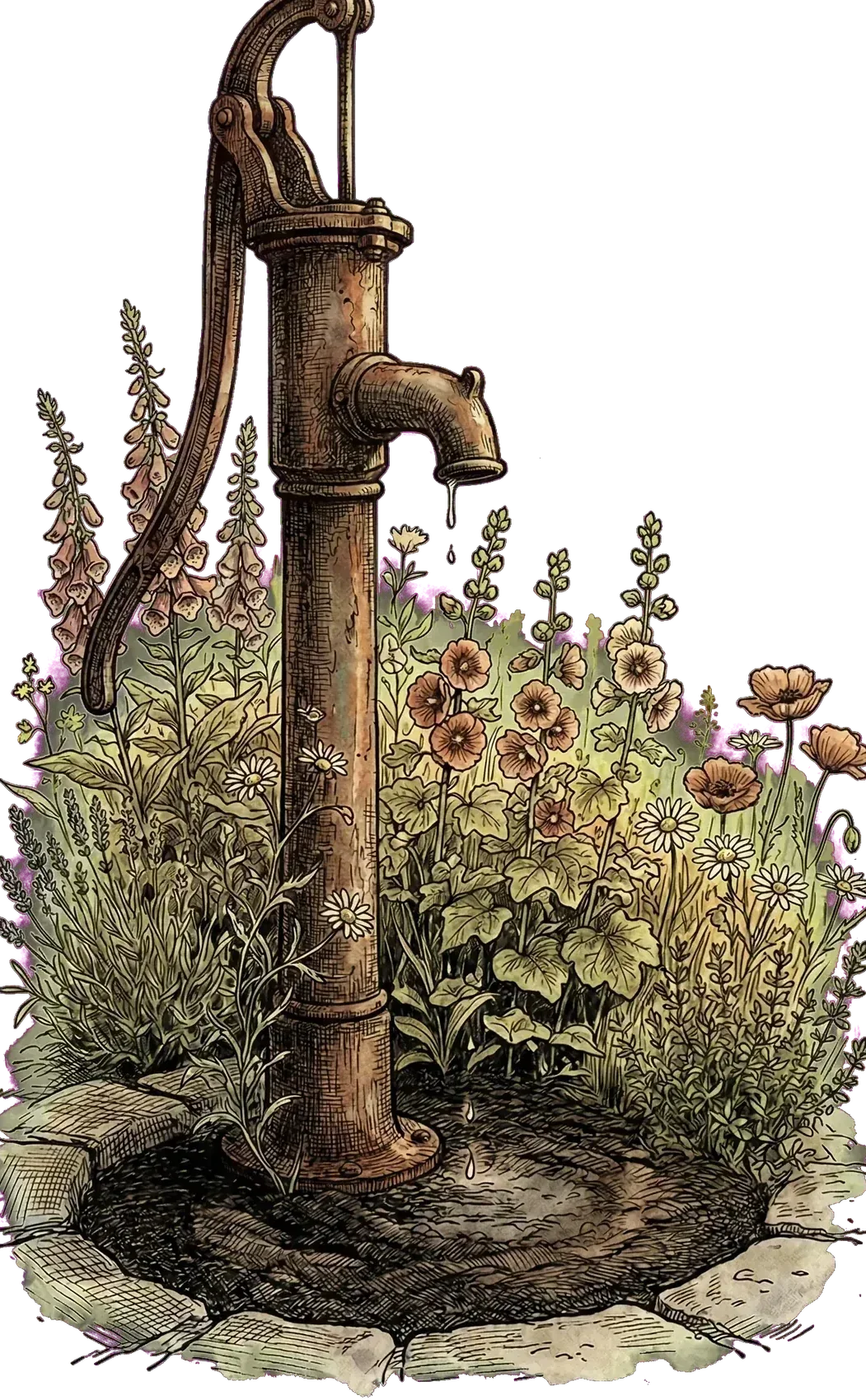
It came first as absence--the absence of her own voice in her own head, the indictment gone quiet mid-sentence. Then it came as presence. Wind moved through a gap in the hedge and she heard it: a thin, threading sound, patient and aimless, going where it liked. A bee landed on a stem near her hand and the stem dipped under its weight, slowly, like a nod. The pump behind her dripped--one drop, then another, each striking the stone basin with a sound so small she wondered that it could be heard at all, and yet it was the clearest thing she had heard all day. Somewhere in the soil beside her--she could not have said how she knew--something ticked and settled, the way a house ticks when the fire goes out: the earth cooling, or breathing, or merely being what it was without her permission.
She sat in the spilled water on the warm stones, and for the first time since she had come into the garden, she was not doing anything at all.