What Clever Hands Cannot Do
An original story in the world and voice of George MacDonald.
She had her question ready. She had carried it through the gate like a coin in her hand:--"What do you want me to do first?" It was, she thought, the right sort of question. It showed willingness and did not surrender; it took up the work and would not bow to the worker. She had said it over twice on the path, and it rang well, and she was pleased with it.
But I must tell you something about questions before we go on, and I am not sure that I can tell it rightly, but I will try. A question that you have polished and carried about with you and said over to yourself is not, properly speaking, a question at all. It is a little performance. A true question comes out of you the way a bird comes out of a bush—suddenly, and perhaps not in the direction you expected; and half the time it frightens the asker more than the asked. Emma's question had been rehearsed, and had therefore no more life in it than a pressed flower, and that is a thing which looks very like a flower but is flat and dry and will not grow; and so perhaps it does not much matter that the old woman did not look up when she asked it.
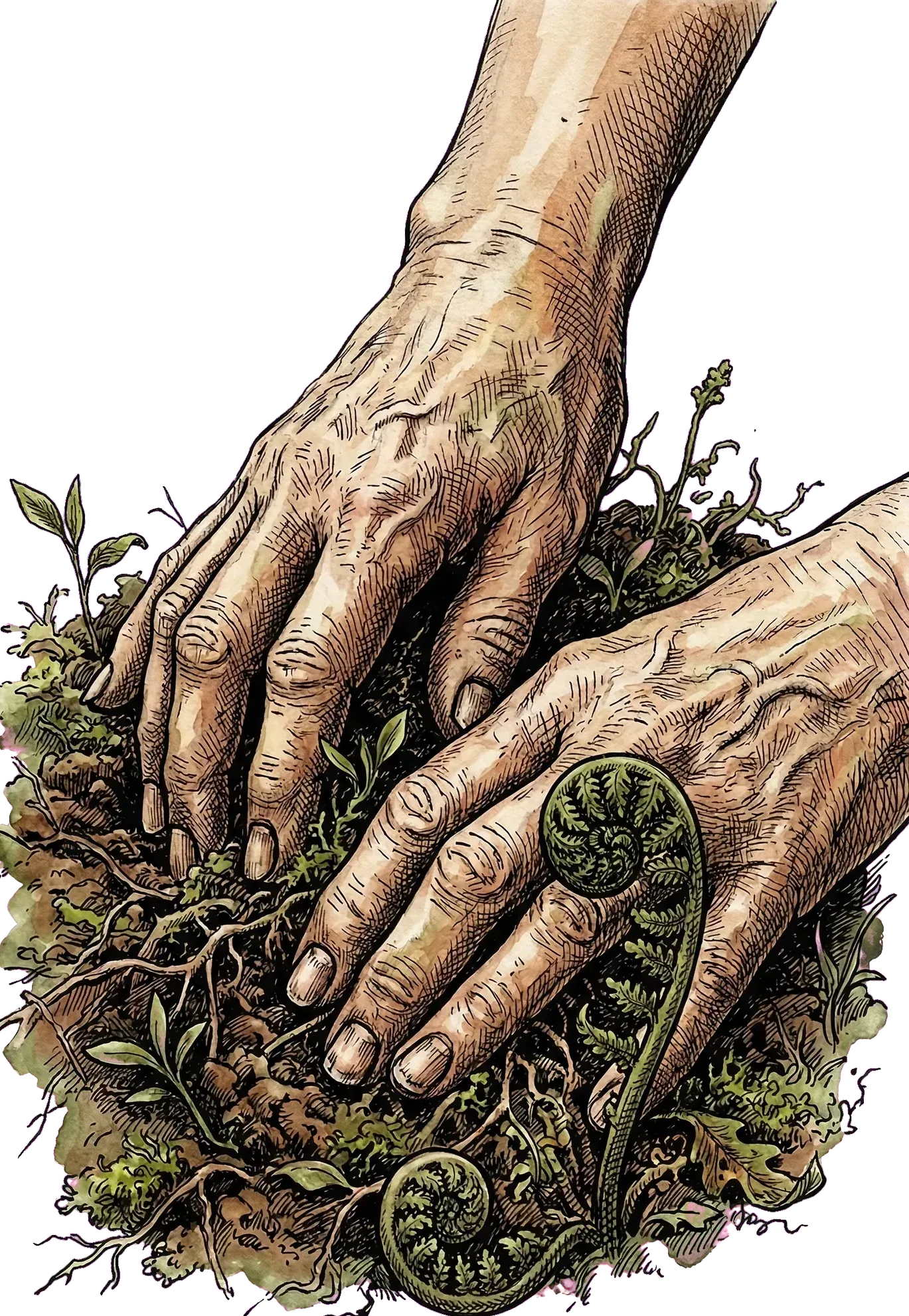
The old woman's hands moved in the dark soil. They were broad hands, brown and rough across the knuckle, and the soil had got into the creases of the skin so that the lines of the palms were written in earth. I think if you had seen those hands you would have felt something; I cannot tell you what. It is the sort of thing that has no name, and is the better for not having one, for we are in the habit of believing that when we have named a thing we have understood it, and that is a very old mistake and a very common one. The fingers found a root and followed it down; and they did not pull but seemed to listen, the way a mother listens for the breathing of a child in the next room—not doing nothing, but doing the most important kind of something, which is waiting for the moment that is not yet. And the root gave itself up. I do not say that the old woman pulled it, for she did not; I say that the root gave itself up, and the ground opened after it softly, as a hand opens that has been holding a thing it no longer needs.
There was no effort. There was no method that Emma could see and name and put into a little box in her mind. There was only a completeness of attention so entire that it had in it something—I do not like the word holy, for it has been used too much and too carelessly, but I cannot find another that will do—something of holiness; and for one breath, one only, something stirred in Emma that she had not felt since she was very small. You know the feeling, perhaps. It is like coming round a corner and seeing a light in a window and knowing, without reason, that the room behind it is a room where you would be happy; and then walking on, because you were going somewhere else and you had your coat buttoned and your errand fixed; and the light stays in you for a moment and then it does not. That is what happened to Emma's feeling. It stayed, and then it did not.
Such feelings go easily when we send them away. That is the pity of it; and that is the mercy of it too, for if they stayed against our will we should never come to choose them freely—but I am getting ahead of my story, and that is always a bad thing to do.
"What do you want me to do first?" she said.
The old woman lifted one hand—not toward Emma; not quite; more as if the hand were finishing a thought it had begun in the earth—and pointed to a bed at the near end of the row. Then she went back to her work. And that was all.
No word; no look; no instruction. Emma stood with her rehearsed question hanging useless in the air, and the argument she had prepared behind it, and the counter-argument behind that, and the whole bright arsenal of her cleverness with nothing to strike against. It is a curious thing to be armed for a battle that nobody will fight, and I do not think there is a lonelier feeling in the world. You cannot be victorious over a person who has not noticed that there is a war on. It takes the shine off considerably.
But Emma was not the sort of girl that stood about. She knelt. The bed was thick with chickweed and dandelion and the small creeping things whose names she did not know but whose habits she had read about, and she set her hands to work with quick, correct motions—grip low, pull steady, shake the roots free of the soil before casting them aside. She had read a book on kitchen-gardening the autumn before; not that she had meant to garden, but it had stood on a shelf and she wished to know whether it held anything that she did not already know. It did not—or rather, it did, but the things it held that she did not know were not the sort of things that could be written in a book, and so she had shut it and felt confirmed, which is the feeling that books most often give to people who read them in that spirit. She remembered the book now and was satisfied, and her hands moved the faster for it.
The weeds came up easily. They gave her no fight at all; and that should perhaps have told her something, but it did not. In ten minutes she had cleared half the bed and felt that quick warm pleasure that comes of seeing your work spread out behind you, visible and done. It is a good pleasure in its way. I do not despise it. But it is not the deepest pleasure, and it can lead you wrong if you mistake it for the thing itself—the way that a signpost is a good and useful thing but you would be a fool to build your house next to one and call yourself arrived.
She sat back on her heels and looked at what she had done.
And here I must say something that I do not know quite how to say. I have been trying for some time and this is as near as I can get, and I am not satisfied with it, but here it is. The bed looked worse. Not untidy—she had been far too neat for that. But the soil lay turned and pale where her fingers had opened it, loose and dry and ashen-coloured, and it would not settle. It had the look—I think you may know what I mean if you have ever been handled briskly by a person who did not much care whether you were you or somebody else—it had the look of a thing that has been attended to but not loved; and there is a great difference between those two, though we do not always know it.
Now you must not think that Emma had done the wrong thing. She had done exactly the right thing, in exactly the right way; and that is what made it so wrong. For there is a rightness that goes deeper than method—I cannot say how deep; I do not think anybody can—and it cannot be got at by study, though study is good and I would not speak against it. There is a way of touching a living thing that tells it whether you have come to help or only to handle; and the earth, that has been worked by all manner of hands since the first Garden, has not forgotten the difference, though we have. That is the sort of thing that sounds like fancy when you say it in a room, but sounds like sense when you say it in a garden. And we were in a garden.
Emma frowned. She took hold of another weed—correctly; quite correctly—and drew it up and laid it on the pile. And she did not look behind her at the old woman's bed. Or rather, she looked once and quickly and then turned away; but she had seen it. The soil there lay dark and closed-over-soft, and you could not tell what had been tended and what had merely grown; and the difference between that bed and hers was the difference between—well, I was going to say between a sleeping child and a made bed. Both orderly. But only one alive.
The sun fell warm and quiet on the garden. At its centre stood the pump—an iron thing, black and patient, with a circle of damp at its foot where water had come and gone and come again. And beyond the pump the far beds lay green and heavy with leaf, and looked glad, if a bed can look glad; and I believe that it can. But in the near beds, here where Emma knelt, the soil was cracked and pale and dry, as a throat is dry that has wanted to speak and has not spoken. And I will tell you a thing about that pump and that dryness, though I am not certain that I understand it myself, and Emma did not know it then, and would not have believed you if you had told her:--the pump worked. It had always worked. But a pump, as you know, must be asked before it will answer; and Emma—but no. But we will come to the pump by and by. For now, the dry beds stayed dry, and the iron pump stood in the sun, and waited.
The weeding had gone well enough—or so Emma thought. She had cleared the bed that the old woman pointed to, and cleared it thoroughly; and if the old woman had not once looked at the work, that meant nothing, for there was nothing to find fault with. The bed was clean. The soil lay open and dark and ready. Emma's knees ached and her fingers were stained, and she was aware—dimly, the way one is aware of weather—that she had not spoken a single word since entering the garden that morning, though she had prepared a great many.
It was then that the old woman brought the tray of seedlings and set it down between them without ceremony, the way one sets down a dish of potatoes; and the gesture said, as plainly as any word could have said it: here is the next thing.
They were small starts; pale-stemmed and leaning all one way toward the light with that frailty which belongs to every young creature that has not yet taken root in the world. Emma looked at them and felt—I think—something very like relief. For this she knew. She had read about transplanting; she had read about a great many things; and reading, to Emma, had always been a kind of mastery. The angle of the dibble, and the depth of the hole, and the gentle firming of soil around the base—she could have written it out as a lesson, and the lesson would have been correct.
But I am going to say something here which the reader may think has nothing to do with gardening, and indeed it has not, and indeed it has everything to do with it:—that there are people in the world who understand the map of a country so thoroughly that they believe they have walked in it, and that they will argue with the native-born about the colour of the heather and the taste of the water; and they are not liars, for they truly see what they describe—only they see it in the map, and not in the country. And what they lack is not knowledge but imagination; for imagination is that faculty by which we enter into the life of another thing and know it from the inside, as God knows it; and without that faculty a woman may hold the whole doctrine of transplanting in her head and yet have no notion—not the faintest—of what it is to be a seedling that must give up one home and trust itself to another. Now whether Emma was such a person or not, I leave the reader to judge; but I will say that she took up the first seedling very correctly, and set it into its hole very correctly, and firmed the earth around it with the exact pressure that the best authorities recommend.
And it died.
Not all at once. It listed sideways first, slowly, the way a man leans that has lost the strength in his legs; and then the pale stem curled downward, and the small leaves—which had been reaching—stopped reaching; and before Emma had moved to the next, the first was lying flat against the dark earth. I do not know whether a seedling that dies in this fashion has gone somewhere, or whether it has only ceased; but I know that the green went out of it the way a light goes out of a window when the person inside has left the room and gone deeper into the house—and whether there is anything deeper, I suppose, is the whole question.
She did not stop. She was not the sort of person who stops. The second seedling curled its stem as if it wished to creep back into the tray. The third stood for a moment—but only a moment. By the fifth, Emma's hands had begun to move faster, as hands do when they are trying to outrun a thought that is gaining on them; and the thought was this: that she was doing everything right, and that everything she did was dying. The sixth lay flat. The seventh never stood at all.
Now I said I would leave the reader to judge, and so I shall; but I cannot help remarking—for it has long been a puzzle to me, and I have never come nearer to solving it than I am at this moment, which is not very near—that there is a difference between the hand that gives and the hand that takes, and that they may be the same hand. I knew a woman once who could arrange flowers so that everyone who entered the room felt that the flowers had been waiting for them; and I knew another who arranged the same flowers in the same vase and made them look like prisoners standing in a dock. I never understood it. I am not sure it can be understood; I think perhaps it can only be known. But the old woman was planting too, and I must tell you what her seedlings did.
Three rows distant, she worked from the same tray. Her hands moved without any method that Emma could have named—indeed, they moved in a way that would have failed any examination that Emma could have set—and yet each seedling she put into the ground stood. Not merely upright but alert; rooted; present in the earth the way a child is present in its mother's arms, which is to say, entirely and without any thought of being elsewhere. The same soil. The same sun. The same pale starts of life drawn from the same wooden tray. And Emma's lay dying, and the old woman's stood; and there was no argument that could make the dead ones stand or the living ones fall; and because there was no accounting for it, Emma accounted for it.
"The drainage is wrong," she said, and her voice came out louder than she had intended—it rang against the still garden air the way a stone rings on frozen ground. "You can see it in the colour of the soil. The earth at your end is a full shade darker; it holds the moisture differently. And these seedlings—" she lifted one from the tray and held it up, turning it this way and that, the way a child holds up a thing it has found and does not know whether to keep or to throw away—"these were already stressed before ever they came out of the tray. Look at the leaf-curl. Look at the stems, how they have blanched. And the angle of the sun is far too direct for transplanting at this hour; there is no shade-cloth, no shelter; the whole of the exposure is wrong."
Every word was accurate. I say it plainly: every word was accurate. She could have defended each claim before any company of reasonable minds, and she would have carried the day; and the seedlings would still have been dead. But a mind like Emma's does not attend to such things, or rather—it attends to them and then adds them to the argument, the way one adds wood to a fire that is already burning the wrong thing.
The old woman only listened. Her hands were still in the soil; her face was turned toward Emma; and her expression was not agreement, and it was not disagreement, but something altogether harder to bear than either. It was patience. Not the thin patience of someone waiting for you to finish—Emma knew that patience well enough; she had seen it on the faces of people who disagreed with her and had not the quickness to say why—but a patience that went all the way down, that had no bottom to it, that did not even know it was patience because it had never been anything else. It was like arguing with the sky. It was like arguing with someone who loved you so completely that your argument could not find a surface to strike against but only fell inward and inward and met no resistance and so could not stop falling.
So Emma argued with the sky. She spoke of root-loss and transplant-Loss—I put the capital letter there because that is what her voice did with it, a kind of hardening, as if the word thus spoken were a technical term and therefore settled—and of the mineral composition of clay soils and the orientation of beds relative to the prevailing wind. And the words were true words, good words, the kind of words that carry weight in places where words carry weight. But this was not such a place. They fell into the garden air and vanished, the way water vanishes into a stone that has been sitting all day in the sun—a moment's darkening, and then nothing, and the stone no cooler for it.