The Wall and the Gate
An original story in the world and voice of George MacDonald.
Composed through a multi-agent pipeline built on the Claude Agent SDK. Nine MacDonald works studied, 408,000+ words profiled. How it was built is documented in the process articles.
This story was composed by an artificial intelligence trained on the works of George MacDonald. It is original fiction, faithful in voice and spirit to MacDonald's fairy tales, produced through a pipeline of planning, writing, and critical evaluation. No passage survives without meeting a rubric drawn from MacDonald's own prose. What follows is pastiche in the oldest sense: an act of apprenticeship, rendered in a voice not the author's own.
Emma had been ready since six o'clock. She had laid out her arguments in order - the way one lays out tools for a task that wants doing properly - and every one of them was good. She could have been at the library. She could have been finishing her exercises in counterpoint, which Mr Ashford had said were unusually precise for a girl her age; or indeed for anyone. She could have been doing any one of a dozen things that would have added, in however small a degree, to the sum of her competence, which was already considerable, and which she tended with the grave and anxious attention that other children gave to living things.
I say anxious; for that is nearer the truth than Emma would have allowed. There is a kind of pride that is not vain - not at all - but that works ceaselessly to build, and to build well, because it cannot rest in anything it has not made for itself. It is the pride that will not receive. And that is the very pride that shuts the door against half the good in the world; for the best things cannot be earned, and the greatest cannot even be sought - they can only be found by one who has left off looking, or given to one who has forgotten that she was in need.
But Emma's mother only said, "You'll be home for supper," and kissed her on the forehead; and her father touched her hair; and then they were going down the lane together before Emma could deliver even the first of her preparations. The arguments, so neatly laid, met no opposition. They had nowhere to go. They hung about her in the morning air, and the morning air did not mind them.
She stood before the gate in the wall.
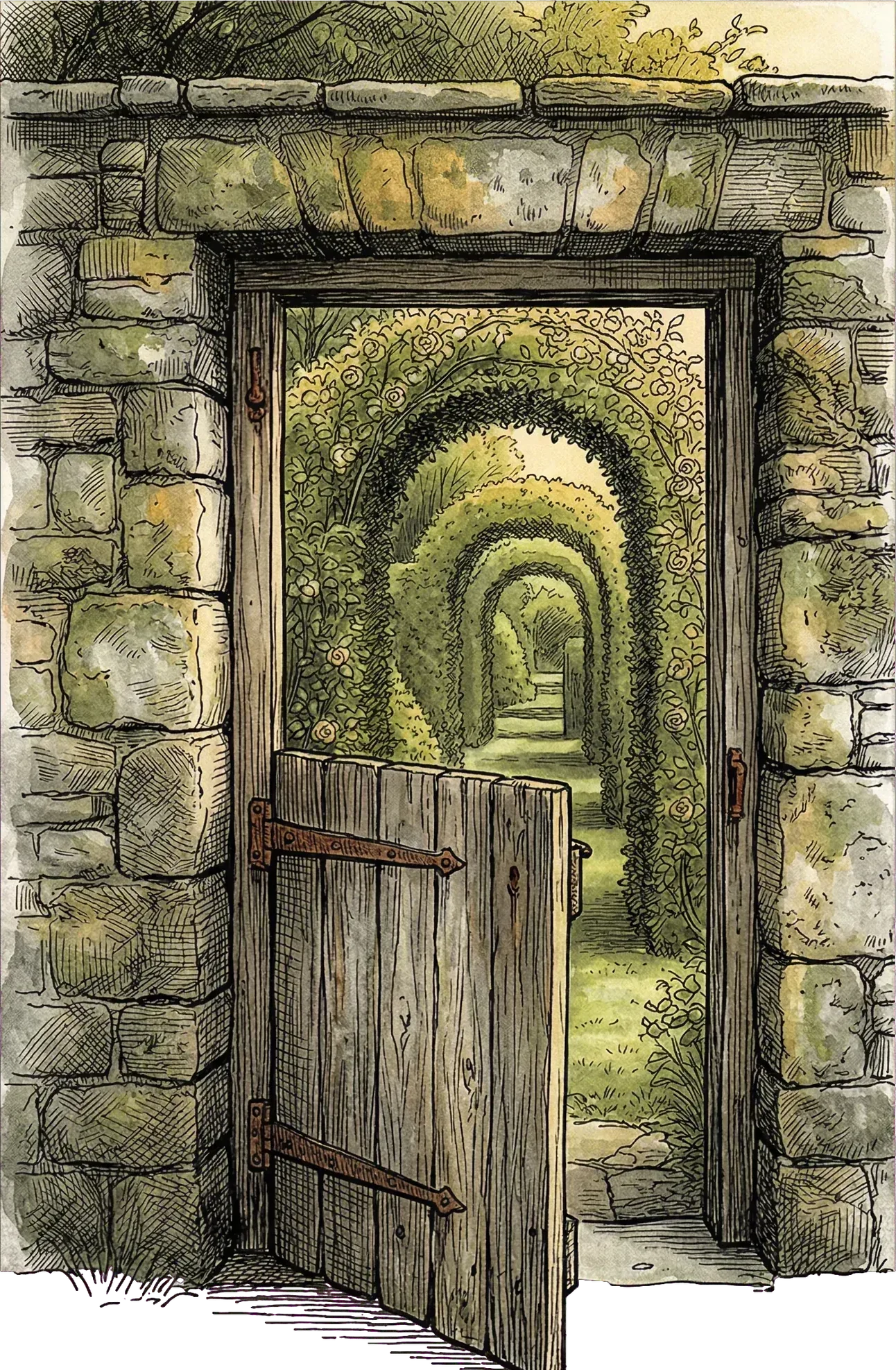
It was old stone - warm already with the early sun, who had been at his work there long before Emma came, and had laid his hands on every crack and roughness as if he knew them each by name. The wall was taller than it had looked from the lane. The gate was wood, grey with years and soft with them; and it opened at her touch so lightly that she felt almost offended, as though it had not thought her worth the trouble of resisting. But when it closed behind her, it shut with a sound deeper than its size - a sound that belonged to a heavier door, or a far older one; and the latch fell into place with the quietness of a thing that has been closing for a very long time and that knows well what it is about.
Now I must try to tell what Emma saw; but I am not sure that I can tell it rightly, for the garden was one of those places - and there are more of them than we suppose - that do not show the same thing to the same pair of eyes twice, and that will not hold still for a description any more than a stream will hold still for a portrait. But I shall do what I can.
The garden was not what she had expected. She had expected to see the whole of it at once - a plot, a few beds, a wall on the farther side - the kind of space one could take in with a glance and have done. But the beds receded. They went back through archways of privet and briar that had grown together into green-vaulted passages, and through those archways were further beds; and beyond those what appeared to be stone steps going down - which was strange, for the ground outside the wall was level, and the lane had not descended. The garden went back, and it went down; and it went further in both directions than the wall could possibly contain.
The morning light entered with her. It came over the wall and fell into the nearer beds the way that living water falls into a pool - with a kind of gladness, as though it had been waiting to be let in. It lay among the roses and the sage; it brightened in the leaves of a low plant Emma did not recognise, whose flowers turned their faces upward as to a friend. But the light did not reach the further sections. Those withdrew into a green dimness that was not shadow - I cannot call it shadow, for shadow is merely the absence of light, and this was something else; it was the presence of depth. It was not dark there. It was full; but with what, Emma could not have said.
She tried to take it all in. She was accustomed to taking things in; it was what she did best, and she did it quickly. But the garden would not be taken. It came to no summary. It answered no question that she knew how to ask, and it asked - but here I must be careful. The garden did not precisely ask anything. It was simply there; and its being-there was of a kind that made Emma's quick certainty feel thin, as a candle-flame looks thin and pale when you carry it out into the sunlight.
At the far end of the nearest bed - or what she supposed was the nearest, though the distances were already less certain than they ought to have been - an old woman knelt in the soil. Her hands were in the earth to the wrist, and the earth received them as water receives a stone that belongs to its bed; there was no displacement, no disturbance, only a quiet completion. She did not look up at the sound of the gate. She did not look up at Emma's footsteps on the path. She was attending to something; and whatever it was, it was more present to her than Emma was. After a long moment she raised her head; and her eyes - they were grey, and very clear, and had in them neither curiosity nor welcome nor rebuff - met Emma's with the brief acknowledgment that one gives to a familiar thing. A bird on the wall. The morning itself. She lifted one earth-dark hand and gestured - not at Emma, but past her, toward the further garden; then she returned to her work, and her hands went back into the ground as simply as roots.
Emma stood inside the wall. The gate was shut. The sun was warm on her back, and before her the beds went on into archways and descents that she could not account for and that did not trouble themselves to be accounted for. She had her arguments still, every one of them precise and unanswerable; but there was no one to answer them. And the garden - patient, heavy with bloom, going down into its own depth like a thing that breathes - was already, in its quiet and ancient way, offering her something she had not thought to want; and she had not yet the grace to see that it was an offer, or the humility to know that she was in need.